

Canada has a Defence Digital Strategy
A full breakdown and analysis of Canada's new Defence Digital Strategy and why it's a big deal for Canadian industry

On June 30, Canada quietly released a Defence Digital Strategy titled "Mission Ready, Digitally Driven." This is the highest-level document to date addressing the Department of National Defence (DND) and the Canadian Armed Forces’ (CAF) lack of digital modernization and the need to chart a path forward. In Canadian fashion, there was no official government launch or announcement of the strategy. At the moment, it is unclear whether this was a soft launch that will be followed by a larger announcement with additional details, or whether it is emblematic of the government’s regard for cyber and digital technologies.
This new strategy makes strong statements about digital sovereignty and supports Canadian industry, so it is surprising that this has had such a muted launch. For today, you can read a review of why this Strategy is so important, especially for Canadian industry, and download the document at the bottom of this page.
Feature your business in Canadian Cyber in Context through sponsorship or advertising.
Short Background on DND/CAF Digital Transformation
Since Canada’s 2017 defence strategy Strong, Secure, Engaged, the Department of National Defence and Canadian Armed Forces have been undergoing major digital modernization. By most metrics, this has been a slow and cumbersome process.
Some of the piecemeal efforts have included strategies by the Canadian Army (Modernization Vital Ground: Digital Strategy) and the Royal Canadian Navy (Digital Navy Initiative), as well as a Forces-wide Digital Campaign Plan.1 At the time, the 2022 CAF Digital Campaign Plan was the most comprehensive document covering CAF digital capabilities and established the goal of becoming digitally modern by 2030.
The Digital Campaign Plan established a plan for National Defence and the Army, Navy, and Air Force to continue their siloed efforts in digital modernization while working towards a defence-wide, unified approach by 2025. A reading of Canada’s new defence digital strategy shows the influence of the Digital Campaign Plan and indicates that it remains the foundation guiding DND/CAF. These efforts would be reinforced by the 2024 defence update, Our North, Strong and Free, which stressed that the CAF needed to become a data-driven organization, accelerate digital transformation, and upgrade infrastructure.
Digital modernization efforts post-Digital Campaign Plan have largely been successful, which culminated in the creation of the Digital Services Group (DSG) and CAF Cyber Command (CAFCYBERCOM) in 2024. Despite the major progress in many areas, there remain deficiencies in many others, particularly in the procurement of major capital projects like secret cloud. Although the Digital Campaign Plan remains relevant through to 2030, the new Defence Digital Strategy elevates the priority of digital modernization to the level it requires. In addition, as will be shown, this strategy indicates major changes for how Canada engages in digital capabilities and cyber defence, particularly with Canadian industry.
What is the Defence Digital Strategy?
The Defence Digital Strategy is meant to accelerate the digital modernization of Canada’s military. The Strategy outlines the goals of digital modernization for Canada’s national defence ecosystem and the pathways and steps to achieve them.
Digital capabilities are central to how the CAF operates on a daily basis and in wartime. However, the digital capabilities and skills that DND/CAF currently possesses are not what it desires or needs to support its operations. The CAF Digital Campaign Plan was released in 2022 and focused solely on the CAF because the CAF could no longer wait for DND to prioritize digital modernization. As a result, the Defence Digital Strategy is the government and National Defence catching up to the military’s planning, which has been waiting for this strategy for years. This is why a careful reading of the Defence Digital Strategy will show significant alignment between the two, as the CAF Digital Campaign Plan was the foundation on which the new strategy was built.
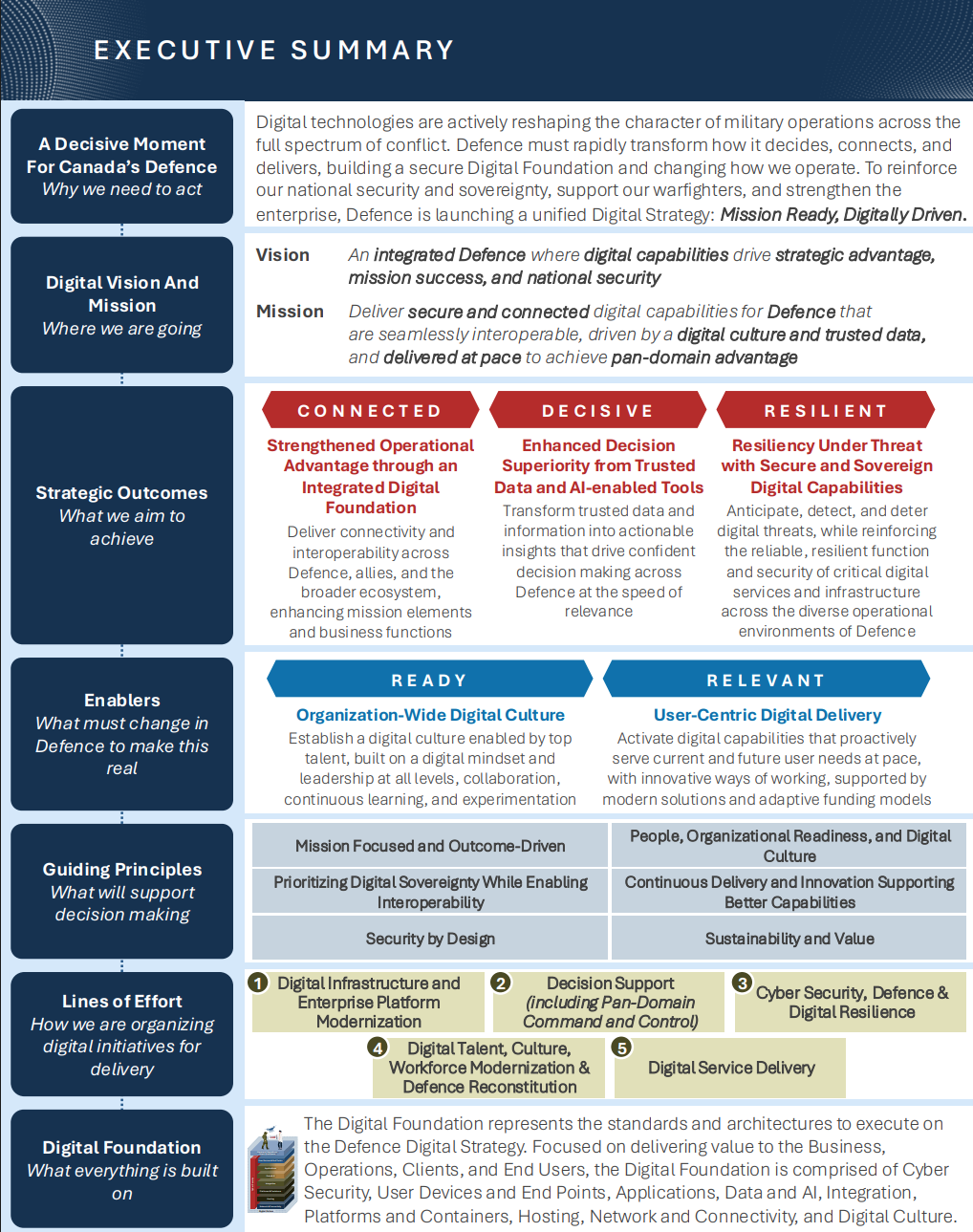
Executive Summary
There are a few central themes that you will find in this strategy.
The first is “unification” or anything “-wide.” DND/CAF has historically developed digital and cyber capabilities in very siloed approaches; this includes how these capabilities have been managed in the first place. Prior to the creation of the DSG in 2025, multiple organizations managed specific aspects of DND/CAF’s digital enterprise. The creation of the DSG and CAFCYBERCOM helped resolve this to some extent, but many barriers and issues persist.
The second is related to “pan-domain” and everything related to enabling pan-domain operations and fighting. Pan-domain and pan-domain command and control (PDC2) is referred to as multi-domain in NATO and Combined Joint All Domain Command and Control (CJADC2) in the United States, respectively. This is important because PDC2 is the operating concept the CAF is moving towards, which focuses on data-driven operations using cloud computing, big data, and artificial intelligence. This is not a new concept either, but is almost 10 years old at this point.
These are what are central to both the vision and mission of the Defence Digital Strategy. The vision of the Defence Digital Strategy is an integrated defence team that can use digital capabilities to have a strategic advantage in any operation the Government of Canada requires of them. The mission is to develop/acquire secure capabilities to ensure that Canada can conduct pan-domain operations.
However, while these two themes are central to the reasons for digital modernization, there is also an acknowledgement of the current state of the global threat environment. There is strong support for digital sovereignty and buying Canadian to support Canada as a “digitally advanced and self-reliant defence actor.” To ensure this, the government is explicitly saying that the way it has done business is not working for digital and cyber capabilities, and that how it manages and procures digital capabilities will need to change.
Strategic Outcomes
These outcomes are what Canada aims to achieve through the digital strategy. These are the core capabilities that Canada will seek to procure for the CAF.
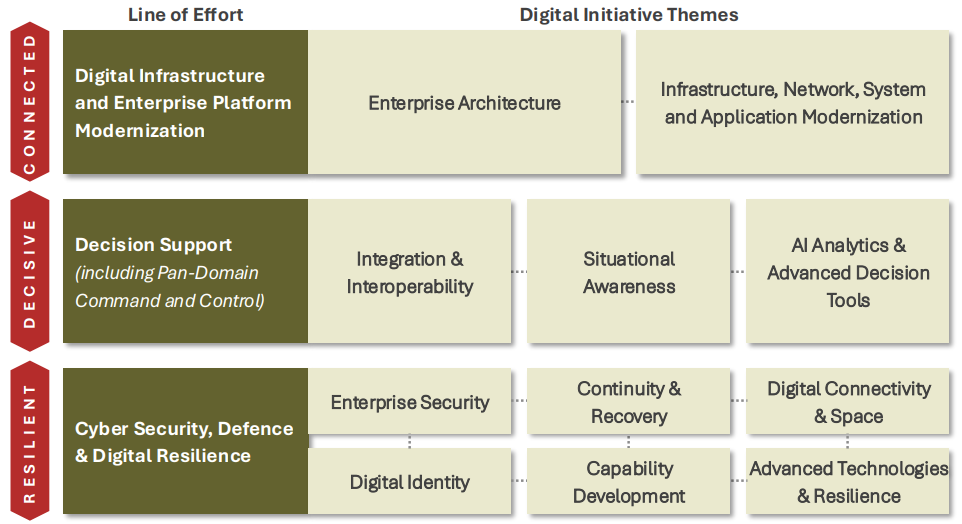
Connected focuses on the backbone infrastructure and the ability to use digital capabilities in the first place.
This is where a lot of upgrading and modernization still needs to occur. DND/CAF still has a lot of legacy infrastructure and major gaps in connectivity, especially to the cloud. Connected is not just about upgrading to the cloud, but about upgrading the entire legacy digital foundation and infrastructure to enable an “internet of military things” and future capabilities.
Also important to note that there is often what’s known as the “Ottawa bubble.” Because Ottawa is the capital and home to National Defence HQ, most of the best digital infrastructure is deployed there first, then slowly rolled out elsewhere. This leads to a disconnect between leadership and the real, on-the-ground state of digital capability, often leaving them unaware of how badly digital modernization is needed
Decisive centers on adopting data-driven operations to help make better decisions more quickly.
Data fusion is the name of the game! No more siloed data operations, but fuse data from land, maritime, air, space, and cyber. Data fusion is to be supported by AI to process and feed this data to operations and commanders, enabling better, quicker decisions.
Stresses that open architectures and data standards will be adopted to support interoperability.
Resilient stresses the need for all of these digital capabilities and infrastructure to be reliable, consistent, and able to withstand attacks. Cyber resilience is a common term that refers to the ability of an organization or technology to withstand and recover from an incident. As Ukraine shows, modern battlefields have significantly degraded signal/cyber environments, so resilience is key.
Highlights here include an acknowledgement of digital sovereignty “while engaging with global partners” and a “risk-based approach to data and information management across security levels, including for sensitive mission and personal data.”
Also an acknowledgement of the need to work towards quantum-safe encryption.
Enablers
These categories are specifically what needs to change in order to achieve the strategic outcomes.
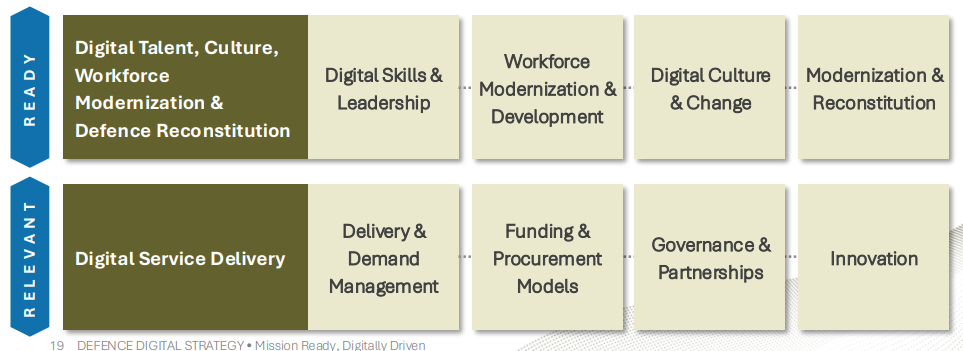
The Ready enabler centers on personnel and culture, and on ensuring that the workforce can deliver on digital modernization in the first place. As noted, this has long been an issue because “cyber,” and signals/electronic warfare to a lesser degree, have tended to be belittled. Anything that is not on the front lines in the CAF has historically been belittled and underfunded. It has only been in the last eight years that there has been real, tangible (slow) change. This is, in large part, because the generation of leaders who underfunded and made terrible decisions about everything cyber and digital in DND/CAF are now gone. DND/CAF are finally starting to build a strong, functional digital enterprise, but significant institutional and technological barriers remain.
The Relevant enabler will be of most interest to defence nerds and Canadian industry. There remain few specific details, but the strategy hints at many changes to procurement and to Canada's approach to digital and cyber capabilities. Digital service delivery, including how projects are funded and procured, is both on the table.
“Adaptive funding models, modernized digital procurement, and optimized business processes will support timely decision making and clear accountability.”
“Achieving this will require a refreshed delivery model that offers a balance between standardization, where beneficial, and enhanced flexibility to meet unique needs across Defence. This delivery model will advance from legacy ways of working towards a product management model, support continuous improvement, and enable iterative delivery.”
This may indicate that the authors of the strategy have been reading growing discourse and support for the adoption of agile procurement, including the Defence Agile Procurement Insights and Analysis project, on which I was a co-author.
“This will also require refreshing governance and renewing relevant policies and legal frameworks to align with operational needs. We must strengthen research and development and Defence-wide collaboration, while fostering synchronization with the broader Defence ecosystem.”
Delivering Digital Modernization
DND/CAF views digital modernization through six guiding principles that frame how they will advance it. Some of these are part and parcel of what you will find in most defence-focused documents, but it still importantly frames how they view developing what will be the command and control, communications, data, and infrastructure backbone to the entire DND/CAF as an organization. The six principles are: mission-focused and outcome-driven; prioritizing digital sovereignty while enabling interoperability; security by design; people, organizational readiness, and digital culture; continuous delivery and innovation supporting better capabilities; sustainability and value.
One thing that has plagued DND/CAF for some time is a culture which belittled cyber and digital capabilities. DND/CAF’s digital and cyber capabilities took a major hit in the early 2010s before Strong, Secure, Engaged due to the “tooth to tail” fallacy, which incorrectly characterizes non-front-line capabilities and personnel as less important to the “tooth” of those who fire the bullets or drive the tanks. This devalued and underfunded cyber capabilities, leading to major gaps and deficiencies across the forces. Since Strong, Secure, Engaged and the slow prioritization of cyber capabilities and digital modernization, this has slowly changed.
Anecdotally, I have heard that there has been a positive shift within the CAF since the establishment of DSG and CAFCYBERCOM in 2024. Nevertheless, the broader digital culture and training are not where DND/CAF wants them to be. This is not just about a supportive culture that thinks digital first, but about a culture and people who understand digital technology and actively seek out and encourage others to learn more if they do not.
However, delivery is still required, which is where many of the problems exist. This ability to deliver digital modernization is about DND/CAF being able to administer digital transformation and procure what it needs, but also about Canadian industry providing the digital capabilities that DND/CAF requires. The strategy is very clear about its view: “We must grow national self-sufficiency and reinforce our supply chains, ensuring critical digital capabilities can be secured, sustained, and evolved within Canada when it matters most.” There is an implicit acknowledgement throughout that Canada cannot develop everything domestically right now for digital transformation, but that does not mean it should not invest in building domestic capacity while working with global partners to ensure a risk-based approach to digital sovereignty.
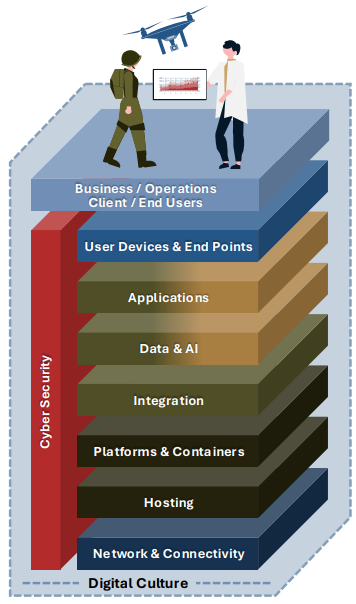
Just as when the strategy is very well-rounded and sound, one of the few concerning elements shows up. According to the infographic above, cybersecurity ends at devices and endpoints. It suggests that users and clients have no role in cybersecurity, which is completely false. The infographic is trying to speak about the broader foundation of the digital enterprise National Defence desires that includes cybersecurity at every level, but overlooks that clients and end users still must apply updates and follow best practices in using the technology. Despite this bad infographic, the rest of the strategy does not appear to reflect this notion, so we should not hold this one error against the whole thing.
So What? - What does this mean?
Canada’s new Defence Digital Strategy indicates a major shift in approach to how DND/CAF approaches digital and cyber capabilities. There is now significant high-level coverage and pressure to prioritize procuring cyber and digital capabilities from Canadian industry. The Strategy is quite clear about the need to increase the procurement of digital capabilities from Canadian industry, but it has yet to make clear how this will be done other than mentioning funding models and procurement.
The Carney government has made a big Buy Canadian push in defence, which has already seen some results, but digital and cyber capabilities have generally been overlooked until now. The new Defence Digital Strategy indicates that this is changing. “Sovereign capability” and “self-sufficiency” are strongly stated multiple times throughout, which cannot be interpreted any other way.
Despite the many positive signs, we should not get too ahead of ourselves. If there is one thing I have learned in my 10 years of researching CAF cyber, it is that National Defence moves at the pace of procurement. That is to say that it moves slowly and is handled by people who often do not understand what is being procured in the first place.
The strategy has indeed indicated that changing how digital capabilities are procured and funded is a top concern, but it provides little to no detail on how it will do this. This lack of detail is common throughout the strategy, but this is to be expected from a 22-page document and Canadian strategy documents tend to be slim on details. We can only hope that the government and DND/CAF will provide more details soon.
Thus far, the Carney government has followed through on defence-related procurement initiatives and advancement for the most part, but digital and cyber has largely been overlooked. Despite AI being a cornerstone of the Carney government’s approach to emerging technology, its overall approach to cyber has been subpar and is better described as marketing than actual governance. There is an ongoing concern about how the Carney government approaches cybersecurity and digital technology, especially in light of Canada’s current National Cyber Security Strategy.
Canada’s latest National Cyber Security Strategy was published last year just before Carney became Prime Minister and has largely been ignored. As a result, the current government does not have a strong track record on cyber and has yet to address cyber defence procurement in any meaningful fashion.
This could change if the government follows through on its new Defence Digital Strategy.

There are other implementation or planning documents I could include here, but these three are some of the highest-level strategies prior to the Defence Digital Strategy.
I sense you are optimistic about the Defence Digital Strategy. Let’s hope the “hares” in DND are in charge of the programme versus the “tortoises”.